Hi
there! Sorry for my disappearance, the end of the term was quite stressful! I'm
finally back and I will catch up with the latest things that have been going on
during the last two weeks.
I will start with very good news (which is kind of unusual in my blog): Filipinos are a great example of how tragedy can deliver great lessons for the future if we are ready to learn from it.  |
| Satellite view of typhoon Hagupit. Image: NOAA
Typhoon Hagupit (known as Ruby in the Philippines), made
landfall last December 6th with winds up to 200km/h.
The balance of this storm was 19 deaths in Philippines.
One year after the powerful typhoon Haiyan, which left more than 7,000 dead in
November last year, Filipinos have learned many lessons.
It is true that Hagupit was a slightly less intense
storm, and, unlike Haiyan, it did not produce the storm surge of 5.2 meters
high which devastated the city of Tacloban, but I think thatit is fair to say that this
time the government was much better prepared. Early warning systems and
preventive evacuations served to greatly minimize human losses.
At least 1.7 million people managed to evacuate their
homes and find refuge in over 5000 evacuation centers. Shelter, food, water,
sanitation and hygiene, health and logistics were among the main priorities.
According to the United Nations, the typhoon was
estimated to affect 2.9 million people in nine different regions of the
Philippines. The official death toll rose up to 19 (including at least seven
children) and 916 injured.
As floods recede, more than half of the evacuees returned
home in the last days. To date, 788,000 people remain in 3,0000 evacuation
centers. Packages of food, water and hygiene kits were distributed to more than
95,000 victims. Meanwhile, government officers are planning to meet with NGOs
to coordinate reconstruction efforts and humanitarian aid.

One of the evacuation centers. Image: Reuters
Philippine authorities, with the support of NGOs,
continue to assess the damage and needs while focusing efforts in the provinces
of Northern Samar, Eastern Samar, and Samar. They have also announced their
goal to provide shelter assistance to affected communities until January 2015.
All national roads are already operational, but six
bridges remain closed in the affected regions. Power outages continue in 12
provinces, while telecommunications coverage was restored to more than 74%.
The UN Office for Disaster Risk Reduction (UNISDR) congratulated
the Philippines and said that this reaction demonstrates the
leadership role that Asia plays in reducing mortality and economic losses from
natural disasters.
The head of UNISDR Margaretha Wahlström said that the
Philippine government has made an excellent job putting into practice the
lessons learned from Typhoon Haiyan.
She added: “We have been telling this story since the Indian Ocean
tsunami ten years ago that nations and communities have the power to reduce
their losses if they are well-organized, understand the nature of risk and
develop the capacity to deliver early warnings and evacuate groups at risk
ahead of the disaster event.” Now it is a demonstrated
fact.
WELL DONE PHILIPPINES!
Btw, here you can
listen to Mary Ann Lucille Sering (commissioner
of the Philippines’ Climate Change Commission and lead climate official for the
Philippines at the Lima conference) talk about adaptation and mitigation in
Philippines
|
Tuesday, 16 December 2014
WELL DONE PHILIPPINES!

Monday, 1 December 2014
The huge economical cost of coastal flooding in 2050
The effects of climate change are enough now-a-days to start assess the economical cost it will cause to humankind in the future.
Climate change, together with population growth in some areas of the world and economical growth, could lead to a big increase of flooding risk in big coastal cities (up to nine times today's risk by 2050).
A paper published in August 2013 in Nature (Hallegate et al. 2013) titled "Future flood losses in major coastal cities" has estimated this cost and is part of a bigger work carried out by the OECD (Organisation for Economic Co-operation and Development) in order to assess flooding risk (particularly due to storms) as a consequence of climate change and urban development from a social and economic point of view.
The new study has been partially based on previous OECD works, which classified the world's port cities on a scale based on their present and future vulnerability to storms taking into account the number of inhabitants and the value of the goods which could be affected by flooding.
Hallegate et al, have calculated the present and future losses due to flooding in 136 of the biggest coastal cities in the world taking into account the existing flood defenses (the city of Amsterdam is an interesting example with and extremely high exposure but small economic average annual losses due to it's extraordinary defenses).
The average losses in 2005 were quantified to be around 6.000 million dollars and could increase up to the mind-bending number of 52.000 million per year by 2050.
According to this metric, most of the more vulnerable cities in the world are part of industrialized countries such as: Guangzhou and Shenzhen in China, Miami, Tampa-St. Petersburg, Boston, New York and New Orleans in the US, Bombay in India, Nagoya and Osaka-Kobe in Japan and Vancouver in Canada.
Due to their high wealth and low protection level, three US cities (Miami, New York and New Orleans) explain 31% of total economical losses in the 136 cities. Adding the Chinese city of Guangzhou, the four cities explain 43%.
The economic cost in dollars is a way of assessing the risk but a more complete way of assessing it is to see these economical losses as a percentage of the city's total wealth.
According to this criteria, Guangzhou (China), Guayaquil (Ecuador), Ho Chi Minh (Vietnam) and Abidjan (Ivory Coast) are within the most vulnerable cities in the world.
%2B20.05.30.png)
To estimate future climate change impact, a sea level rise between 0.2m and 0.4m by 2050 is assumed.
In addition to this, about a quarter of these 136 cities are located in river deltas, and therefore more exposed to river floods, as well as decreases of soil on land or promotion of coastal seabed, due to the local subsidence, particularly in cases where overexploitation of groundwater accelerates natural processes.
In my opinion, one of the most important findings of this study is that even a "moderate" sea level rise would cause substantial increases in losses if adaptation measures are not taken because the defenses against flooding are designed to past conditions.
Doing nothing is not an option, as it could cause losses exceeding one trillion or more per year, according to the study.
Therefore, coastal cities will have to improve its flood action plan, including the construction of good defenses, at an estimated cost of around 50,000 million dollars per year to 136 cities.
The report makes the point that significant increases in the flooding risk in cities which are not vulnerable today may occur.
The five cities with the highest estimated risk increase are Alexandria in Egypt, Barranquilla in Colombia, Naples in Italy, Sapporo in Japan, and Santo Domingo in the Dominican Republic.
%2B20.02.50.png)
Wednesday, 26 November 2014
Fake and Overused Weather Photos
Just came across THIS on Facebook and couldn't resist the temptation to share it with you.
You have my word: I will never ever use this pictures!!!
You have my word: I will never ever use this pictures!!!
The Ridiculously Resilient Ridge
Welcome again to my blog,
as last week's post was talking about the anomalous cold weather in eastern US, I thought that talking about California's drought would make sense. As I said on my last post, US weather is more bipolar than ever!
California is the first US economy and half of the country's fruit is produced in it's central valley. This study by the University of California, Davis (Sacramento) assesses the massive economic impact of the drought (around 2.200 million dollars)
The official state of emergency was declared in January 2014, in order to address the problem and try to find ways to conserve and use water more efficiently. Serious problems related to water use had already begun: farms can not provide water for livestock, thousands of workers in agriculture are loosing their jobs and severe wildfires are taking place, just to name a few.
The gravity of California's drought is so great that it is already changing the geography of the state: one of it's most important rivers is not reaching the Pacific Ocean anymore.
Just look at a couple of pictures:

 |
| Satellite images showing the snow cover over the Rocky Mountains in January 2013 vs January 2014 |
California's Governor Jerry Brown encourages individuals and companies to put to work strategies to try to save water and reduce consumption to 20% or more. While many of these initial measures are directed to residents, the agricultural sector accounts for up to 80% of total water consumption in California, according to MacDonald, 2010. The restrictions on water use are usually applied voluntarily, but in certain areas they have become mandatory.
In early February 2014, a heavy rainfall fell over Sonoma. 2013 was the driest year on record and because of this, soil was very poor in moisture.
When soils are lacking moisture so severely, they harden and crack, becoming less permeable to water and this results in heavy rainfall not being absorbed, causing flash floods.
As the drought deepens, flash floods may become more frequent, bringing new challenges to farmers in the area (including the cannabis industry).
As if it were not enough with these, Amos et al., 2014 link drought with higher earthquake probability.
This is the third consecutive year of drought in California. Now comes the one thousand dollar question... Can we attribute this to climate change?
Let's first check the science behind the event.
During the last three years, a vast anticyclone hast remained over the northeastern Pacific Ocean (the so called "Ridiculously Resilient Ridge" I love the nickname!) preventing the winter storms from reaching California and as a result, bringing extreme temperatures and massive drought to this area.
This is also a consequence of the Rossby waves we talked about in the last post.
In this report, the Stanford researchers Noah Diffenbaugh and David Swain (the video stars) analyze the impact of climate change in this particular event trough a combination of GCMs (Global Circulation Models) and statistical methods which have allowed them to determine whether the formation and resilience of such an anticyclone had been possible in the absence of the effects of Climate Change.
They concluded that the atmospheric conditions driving to this situation in California are very likely related to human-caused Climate Change. In other words, human-caused climate change has dramatically increased the likelihood of extremely high atmospheric pressure over the North Pacific Ocean which has lead to the drought in California.
Thursday, 20 November 2014
U.S anomalous weather
U.S weather is more bi-polar than ever. Eastern U.S shivers from the polar vortex and California struggles in a historic drought.
The "Polar Vortex", one of the buzzwords of 2014, brought news last week by bringing Arctic temperatures to North America and by providing climate skeptics with arguments against Global Warming.
In fact, the scientific explanation behind this blast of cold weather helps to provide a more troubling evidence about the increasing effects of global warming.
What is a Polar Vortex?
These cyclones (vortex) over the two poles of the earth are located in the middle and upper troposphere and stratosphere and move at different speeds. Thanks to them, the cold, dense air over the poles is confined there.
This movement of strong winds is part of the polar front. It is stronger in the winter and decreases or disappears in the summer.
The Antarctic polar vortex is more pronounced and persistent than the Arctic vortex, this is due to the distribution of land masses at high northern latitudes which leads to an increase of Rossby waves in the jet stream (Rossby waves are oscillations that occur in geophysical fluids and are due to the principle of potential vorticity conservation). These waves shape the polar jet stream, while in the southern hemisphere the vortex remains less affected.
When these polar winds decrease significantly, the vortex may be distorted and the result is that the jet stream plunges deep into the southern latitudes.
This video from Obama's Science and Technology advisor could help:
When this strong cold current moves towards low pressure areas, winter storms with heavy snow, intense cold and freezing winds may develop. A cold air outbreak caused by a polar vortex is much larger in area and length than a single storm and can lead to cold waves at multiple locations, but this doesn't always happen.
What is the link with Global Warming?
Last January, due to a polar vortex, America experienced a deep freeze. Cities like Chicago recorded a wind chill approaching -60 degrees Fahrenheit (-51°C). Even some parts of Canada reported temperatures colder than Mars!
However, the international scientific community points out that global warming can play an indirect role in these occasional freezes.
The fact is that, due to global warming, the Arctic is warming faster than the rest of the planet, warming which is accelerated due to the the polar ice melt (change in the albedo). As a result of this, temperatures recorded in the Arctic are around 2º C warmer than they were in the mid-sixties (compared to the overall increase in the average temperature of the atmosphere of Earth which is about 0.7º C, since 1900).
Therefore, the temperature difference between the Arctic and North America is decreasing. This temperature difference causes changes in the air blast around the polar region. The decrease in the temperature gradient that has made the air jet to slow down and develop Rossby Waves, bringing warmer temperatures farther north and more cold Arctic temperatures further south.
Maybe skeptics who take any chance to deny global warming should read about these mechanisms the climate system has to face imbalances.
The "Polar Vortex", one of the buzzwords of 2014, brought news last week by bringing Arctic temperatures to North America and by providing climate skeptics with arguments against Global Warming.
In fact, the scientific explanation behind this blast of cold weather helps to provide a more troubling evidence about the increasing effects of global warming.
What is a Polar Vortex?
These cyclones (vortex) over the two poles of the earth are located in the middle and upper troposphere and stratosphere and move at different speeds. Thanks to them, the cold, dense air over the poles is confined there.
This movement of strong winds is part of the polar front. It is stronger in the winter and decreases or disappears in the summer.
The Antarctic polar vortex is more pronounced and persistent than the Arctic vortex, this is due to the distribution of land masses at high northern latitudes which leads to an increase of Rossby waves in the jet stream (Rossby waves are oscillations that occur in geophysical fluids and are due to the principle of potential vorticity conservation). These waves shape the polar jet stream, while in the southern hemisphere the vortex remains less affected.
 |
| Rossby Waves. Source: knmi.nl |
When these polar winds decrease significantly, the vortex may be distorted and the result is that the jet stream plunges deep into the southern latitudes.
This video from Obama's Science and Technology advisor could help:
When this strong cold current moves towards low pressure areas, winter storms with heavy snow, intense cold and freezing winds may develop. A cold air outbreak caused by a polar vortex is much larger in area and length than a single storm and can lead to cold waves at multiple locations, but this doesn't always happen.
What is the link with Global Warming?
Last January, due to a polar vortex, America experienced a deep freeze. Cities like Chicago recorded a wind chill approaching -60 degrees Fahrenheit (-51°C). Even some parts of Canada reported temperatures colder than Mars!
 |
| Homes are covered in snow in West Seneca, N.Y.,Wednesday, Nov. 19, 2014. (AP Photo/The Buffalo News, Derek Gee) |
The fact is that, due to global warming, the Arctic is warming faster than the rest of the planet, warming which is accelerated due to the the polar ice melt (change in the albedo). As a result of this, temperatures recorded in the Arctic are around 2º C warmer than they were in the mid-sixties (compared to the overall increase in the average temperature of the atmosphere of Earth which is about 0.7º C, since 1900).
Therefore, the temperature difference between the Arctic and North America is decreasing. This temperature difference causes changes in the air blast around the polar region. The decrease in the temperature gradient that has made the air jet to slow down and develop Rossby Waves, bringing warmer temperatures farther north and more cold Arctic temperatures further south.
Maybe skeptics who take any chance to deny global warming should read about these mechanisms the climate system has to face imbalances.
Wednesday, 12 November 2014
No break in extreme events
Reading around about the so-called "climate change hiatus" I just came across this interesting letter published in Nature on the 26th February 2014 by a group of researchers from several countries led by Sonia Seneviratne (Switzerland) indicating how the term "pause" or "hiatus" being applied to the recent period of slowdown in the increasing trend of average temperatures is "ill-chosen or even misleading in the context of climate change".
To assess whether there really is an evolution on the Earth's climate, analyzing the evolution of all the different elements which compose earth's climate is required.
 |
| Extreme Temperature Trend in the US. Source: NOAA |
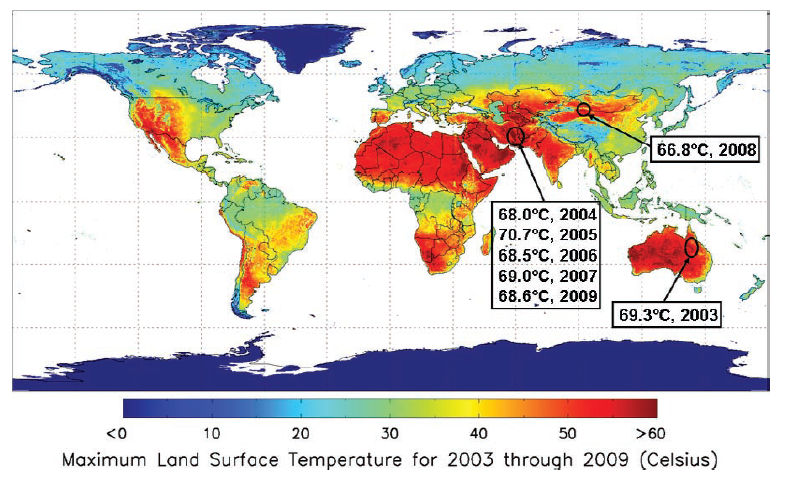
It is true that there' s been a slowdown in the increase of global average temperatures over the past ten years. This slowdown can be linked to several causes such as internal climate variability, a change in the solar energy input, increased stratospheric water vapor or strong La Niña events. But climate is not only composed of mean temperatures.
 |
| Source: http://www.tiempo.com/ |
The authors point out that extremes of warm temperatures haven't stopped growing. In fact, these climatic anomalies have presented the greatest increase over the last decade just like other climate change-related elements such as ice melting, sea level rise and ocean heat content haven't stopped growing. Such rise in the most extreme phenomena indicate without any doubt that there is no such "pause".
Moreover, particularly this increase in warm extremes has negative effects on health, agriculture, ecosystems and infrastructure.
Tuesday, 11 November 2014
Extreme Weather is here to stay
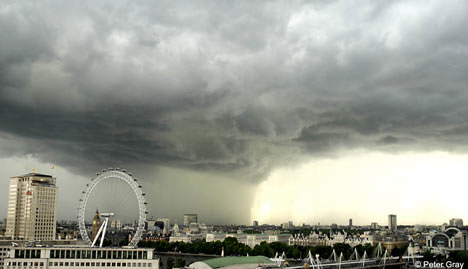
Weather is insane. Or worse... Torrential rains in southeastern Spain in late September. Terrible tornadoes in the US in April. Extreme drought in California and Brazil. Wild fires in Europe (btw aggravated by cuts in public services). All this only in 2014 .... Because looking at the past years we still find many more extreme examples. Remember: In 2012, Hurricane Sandy was visiting New York. Tremendous flooding in Pakistan in 2010 that left hundreds of dead. Cyclone Nargis left more than 130,000 dead after passing through Birmania. The 2003 heatwave killed tens of thousands in Europe: in France alone almost 15,000 were calculated. Among others. (Not to mention earthquakes and tsunamis).
What's wrong with the weather? Is it really changing or is it just a coincidence? What does the climate change have to do in this? In 2014, which will probably be the warmest year on record, there is little doubt left about the existence of climate change. The question is whether climate events in the short term (such as extreme weather) can relate cause and effect via a complex phenomenon and, in the end, of long-term consequences such as global warming.
The Mexican Mario Molina, who shared the 1995 Nobel Prize in Chemistry for his work on CFCs and their effects on the ozone depletion, is very clear: "important changes have occurred in the scientific understanding of the extreme weather events [...]. They are now more clearly connected to human activities, such as the release of carbon dioxide ― the main greenhouse gas ― from burning coal and other fossil fuels "
%2B17.37.49.png) |
| Temperature Anomaly Distribution. Hansen et al. 2012 |
Hansen's article entitled "Perception of climate change" follows the same logic. Dr. James Hansen is the man who popularized the climate change in the political level, in 1988. He was in this period working in NASA and had enough outreach to talk to the US Congress (to an amazed Al Gore, who was in this period a congressman from Tennessee) about his conclusions on the subject: "the Global warming is now large enough that we can ascribe with a high degree of confidence a cause-and-effect relationship to the greenhouse effect." It was the start of a new era.
Hansen, as Molina, affirm we can see climate change modify our weather.
Hansen shows in this paper how the probability of unusually warm seasons has increased, specially in summer.
Hansen has studied the temperature anomalies in the period 1951-1980: a period when the global temperature was very stable, and is useful to compare. Their results show that the probability distribution (frequency of occurrence of temperatures) of local anomalies of the average temperature in the summer were following a normal distribution in the years 1950, 1960 and 1970 in both hemispheres. But each new decade, the distribution would have been flattened and shifted to positive anomalies, ie the zone of higher temperatures (he calls them "hot outliers").
When looking at standard deviations greater than 3, he observes that in 1950 there were 0.1% of the episodes of extreme heat and in 1980 there where 10%. This is 100 times more extreme heat events in 1980 than in 1950. The planet is heating and when it's warm, it is much much warmer.
The same occurs with cold events even if warm events are more frequent than cold ones.
%2B17.35.25.png)
In my opinion, the interesting thing here is that Hansen doesn't use a computer model of climate simulation. He statistically studied empirical data and explained what happened.
He explains successive heat waves that have occurred in recent years, specially in the northern hemisphere. The question is, why did that happen? It is clear that there is a correlation between global warming and increased presence of extreme events, but establishing a cause-effect relation is difficult and Hansen gets his feet wet. He literally says: “[...] we can state, with a high degree of confidence, that extreme anomalies such as those in Texas and Oklahoma in 2011 and Moscow in 2010 were a consequence of global warming because their likelihood in the absence of global warming was exceedingly small“. Perhaps too categorical... and of course, many scientists have disputed that statement.
This happened because it is very difficult to prove this relation. Weber established in 2010 these barriers to understanding climate change. There relation seems obvious, but ... Does that mean that if we successfully attack climate change, episodes of extreme weather will be reduced?
Maybe we just have to be more pragmatic... Munich Re, the biggest insurance company in the world speaks openly about the subject (advantages of not being a scientist).
Their NatCatSERVICE collects data from up to 1,000 natural disasters per year, which it studies and analyzes (worth to take a look). The chart below, shows that extreme natural phenomena have been almost tripled in 30 years.
%2B17.32.38.png)
At the end of 2011, Munich Re was talking about the report "Managing the Risks of Extreme Events and Disasters to Advance Climate Change Adaptation", or SREX. They said pretty much the same as Hansen but earlier: “It would seem that the growing number of weather- related catastrophes can only be explained by climate change. The view that weather extremes are more frequent and intense due to global warming is in keeping with current scientific findings“. And nobody complained.
Whether Hansen is wrong or not, there is something called the "precautionary principle" which is included in the Maastricht Treaty. It is simple:
"If a threat of serious or irreversible damage to the environment or human heath exists, a lack of full scientific knowledge about the situation should not be allowed to delay containment or remedial steps"
According to this principle, action needs to be taken.
Acting or not, that is the question...
Subscribe to:
Posts (Atom)